
WVPA Elderberry to Stillwell Transmission Line Project
Building a stronger, more resilient electric system for Northern Indiana.
Wabash Valley Power Alliance (WVPA), a generation and transmission electric cooperative serving an alliance of 21-member distribution electric cooperatives in Indiana and Illinois, is hard at work improving reliability and performance of its electrical delivery system. Powering more than 285,000 homes, WVPA is investing in infrastructure enhancements as part of their commitment to meet energy needs today and prepare for the future.
The Elderberry to Stillwell Project involves WVPA constructing and operating a new 345 kV transmission line to connect the existing Elderberry Substation in St. Joseph County, Indiana to the existing Stillwell Substation, located in LaPorte County, Indiana. The proposed transmission line is approximately 18 miles long.
Project Area
- Study Area
- Preferred Corridor Option
- Elderberry Substation
- Stillwell Substation
- County Line
FAQs
Public input, combined with technical data, will help refine route alternatives before a final route is selected.
A 150-foot right-of-way is needed for this project, with 75 feet on either side of the center line.
The transmission line will use H-frame poles to minimize land and visual impact.
The first Elderberry to Stillwell open house held in January 2026 introduced the proposed transmission line project and shared initial route concepts connecting the Elderberry and Stillwell substations. This meeting was designed to provide foundational information for the project, explain why the line is needed, and invite early feedback from landowners and community members within the study area. Attendees were encouraged to ask questions and share local knowledge to help project planners better understand community priorities and potential concerns.
The second open house held in April 2026 was built directly on that initial engagement. Based on comments, questions, and preferences expressed by the public, a preferred route and alternative route corridors were presented. This second open house demonstrated how community input, combined with technical and environmental considerations, was used to refine route options and minimize potential impacts.
Together, the two open houses highlight a planning process evolving through public participation toward more informed and community-responsive route alternatives.
The Elderberry-to-Stillwell project is called “network transmission” because it will deliver power across the region via “the grid.” Because this benefits consumers broadly, the asset owner, Wabash Valley Power Alliance in this case, receives revenue from other utilities that use electricity from this new transmission line. The returns go back to Wabash Valley Power Alliance member-owners.
This project is expected to generate economic activity and annual tax revenues to support schools, roads, police and emergency and social services in La Porte County and St. Joseph County where the line will be located. The added capacity to the electrical grid enables new residents and users to connect to the electric system, bringing new tax dollars and jobs.
Corona noise is generated when a transmission line is operating. The noise is created through the discharge of electrical energy, called ‘corona,’ which is audible in the direct vicinity of transmission line conductors during foggy, damp, or humid conditions. This noise is generally described as a low ‘humming’ or ‘crackling’ sound. During dry conditions, the noise may be nearly nonexistent, and during heavy rain conditions, the sound of rain often overpowers this noise.
EMF stands for electric and magnetic fields. For transmission lines, these two should be considered separately- electric fields are measured in kilovolt per meter (kV/m), and magnetic fields are measured in milliGauss (mG). Electric fields depend on the voltage of a transmission line, while magnetic fields depend on the current flowing through the line. The strength of the electric field is proportional with the voltage and decreases rapidly with distance from the conductor. Similarly, magnetic field intensity is directly related to current flow and diminishes quickly as distance from the transmission line’s centerline increases. Learn more about EMFs at EMF Electric and Magnetic Fields Associated with the Use of Electric Power (nih.gov)
While co-locating multiple high voltage utilities on the same transmission structures can reduce right-of-way impacts, it is rarely practical for high-voltage transmission systems due to safety, reliability, and long-term risk.
Key reasons include:
- Structural limitations: Transmission structures are studied and custom engineered with limited reserve capacity.
- Clearance and safety requirements: Different voltages, conductor types, and operating temperatures make it difficult to maintain federally required electrical clearances, especially during extreme weather or emergency operations. Additionally, the Right-of-Way required for multiple high voltage utilities would be extensive and require significant environmental impacts.
- Outage and reliability impacts: Shared structures reduce operational independence. Maintenance or emergency repairs on one system can force outages or delay restoration on another, increasing the risk and duration of service interruptions, and decreasing overall system reliability.
- Long-term liability risk: Over a 40 to 60-year asset life, determining responsibility for structural damage or outages becomes more complex when multiple owners share a structure, increasing legal, insurance, and regulatory costs and exposure.
- Future flexibility: Co-location can limit a utility’s ability to upgrade voltage, increase capacity, or implement new technologies later without affecting another owner’s system.
For these reasons, transmission utilities generally prioritize designs that maintain independent operation, clear accountability, and reliable outage response, using co-location only in limited, carefully engineered scenarios.
- Lower visual impact: 345kV H-frame structures are typically shorter than monopoles, reducing viewshed impacts.
- Smaller ground footprint: Monopoles generally require larger single foundations, while H-frames use two smaller poles that can reduce ground disturbances.
- Structural integrity: H-frames have more structural integrity compared to monopoles. H-frame structures are better suited to handle extreme weather, including high winds and heavy ice loading, making them highly durable.
- Span flexibility: Because of the structural integrity that H-frames offer, spanning of sensitive resources such as wetlands and center pivot irrigation is more manageable.
Project Schedule
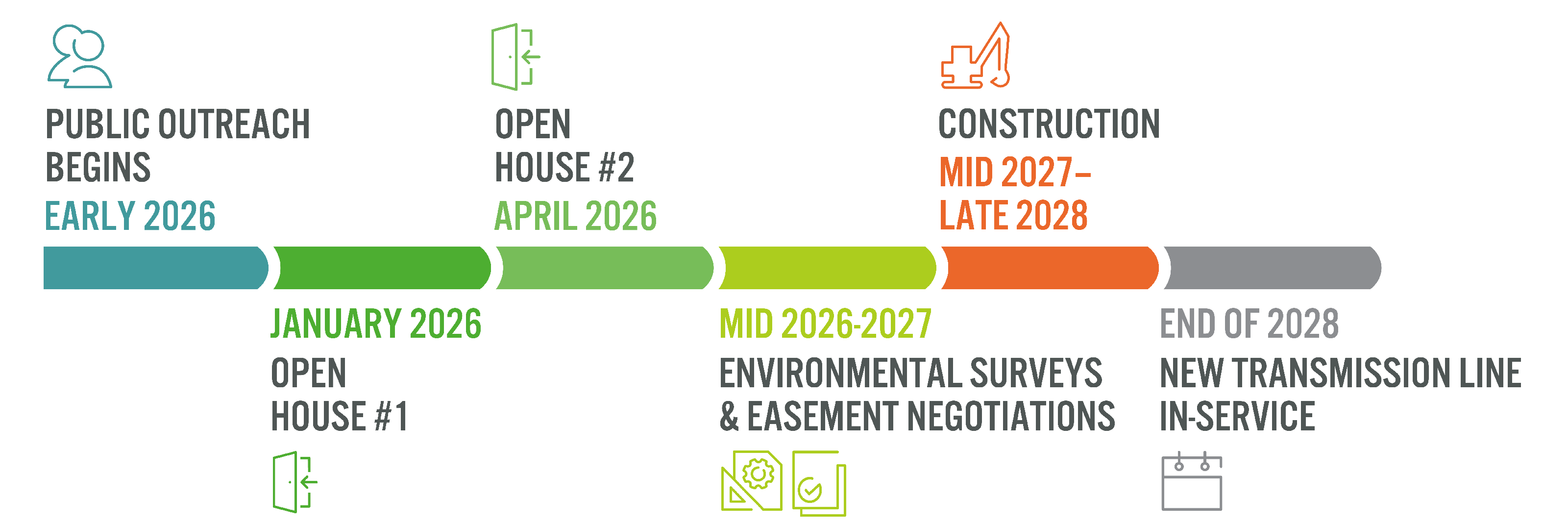
- Early 2026 - Public Outreach Begins
- January 2026 - Open House number 1
- April 2026 - Open House number 2
- Mid 2026 to 2027 - Environmental Surveys and Easement Negotiations
- Mid 2027 to Late 2028 - Construction
- End of 2028 - New Transmission Line In-service
Project Benefits
- Strengthens reliability and helps integrate new sources of energy for future demand.
- Supports economic development and community growth.
- Connects regional generation to the MISO electric grid to deliver increased capacity to members.
- Relieves congestion along the energy grid.



Project Materials
Questions, Comments?
We want to hear from you! Reach out by email, phone, or complete the form below.